 English
 Español
 Português
 Pусский
Understanding the Pneumatic Angle Seat Valve
With 15 years of expertise in manufacturing and global trade, Hearken delivers high-performance valves and actuators. We focus on durability and precision. The Pneumatic Angle Seat Valve is our premier solution for high-cycle industrial applications.
What is a Pneumatic Angle Seat Valve?
1.1 Definition and Core Function
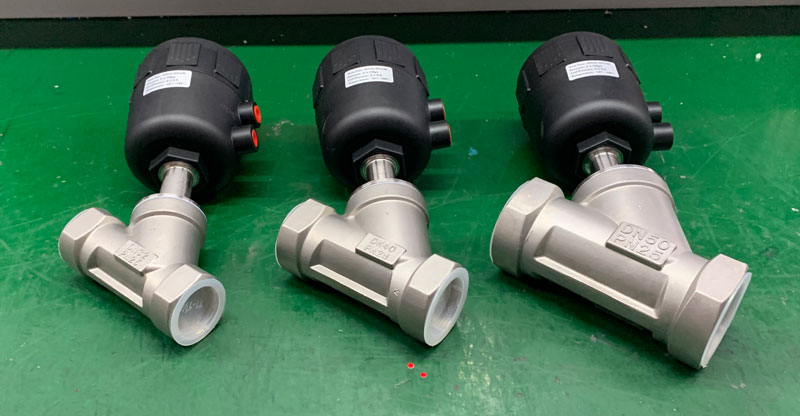
A pneumatic angle seat valve is a 2/2-way actuated unit. It uses air pressure to control liquids, steam, or gases. The "Angle" design allows the plug to retract fully. This creates a clear flow path and reduces turbulence.
1.2 How it Works (The Science of Simplicity)
- The Actuator: Compressed air moves an internal piston to lift the stem.
- The Spring Return: A heavy-duty spring ensures a fail-safe "Normally Closed" position.
- The Seat Seal: The angled plug ensures a bubble-tight shut-off every time.
Why Choose an Angle Seat Valve Over a Solenoid Valve?
2.1 Handling "Dirty" or Viscous Media
Standard solenoid valves clog easily. Angle seat valves have a non-obstructive path. They easily handle scale, slurry, and particles.
2.2 High Temperature Resilience
These angle seat valves handle saturated steam up to 180°C. They are built for aggressive chemicals and extreme thermal shock.
Key Components & Material Excellence
3.1 The Body: Stainless Steel 304 vs. 316
Hearken uses investment casting for all bodies. SS304 is perfect for general use. SS316 is best for high-corrosion or marine environments.
3.2 The Seals: PTFE vs. Viton
We use PTFE (Teflon) for steam and high-heat stability. Viton is available for specific oil-based chemical compatibility.
3.3 The Actuator: Plastic vs. Stainless Steel
- Polyamide: Cost-effective and durable for standard factories.
- Stainless Steel: Vital for hygienic or corrosive wash-down areas
Typical Industry Applications
4.1 Food & Beverage Processing
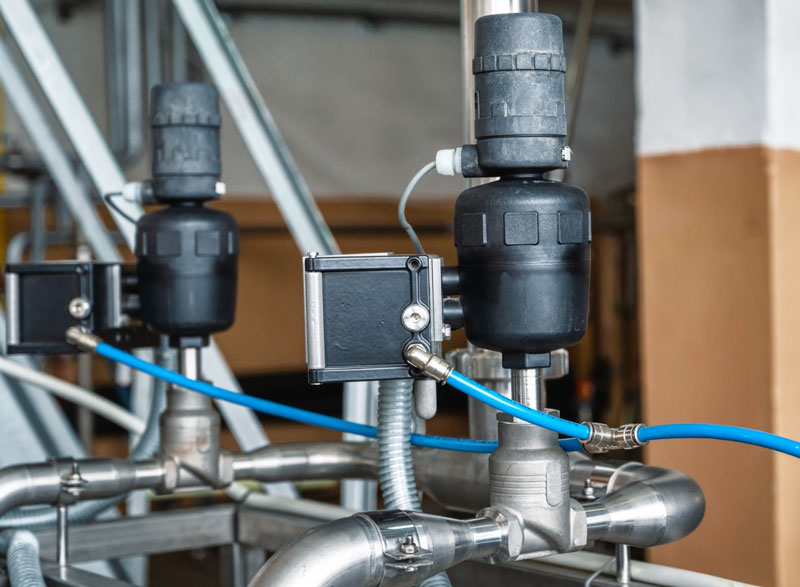
Ideal for CIP (Clean-in-Place) systems. They withstand frequent steam sterilization.
4.2 Textile Dyeing and Printing
Perfect for high-frequency switching. They manage chemical dyes and boiling water without failure.
4.3 Water Treatment & Chemical Handling
These valves resist aggressive chemicals. They ensure long-term operation in wastewater management.
Conclusion: Investing in Quality
Quality valves reduce downtime and boost ROI. At Hearken, we combine 15 years of factory-direct experience with expert trade support. We provide the reliability your production line deserves.
Frequently Asked Questions (FAQ)
Q1. Can these valves be used for vacuum service?
Yes. With the correct seal orientation, they are highly effective for vacuum applications.
Q2. What is the difference between NC and NO?
Normally Closed (NC) stays shut without air. Normally Open (NO) stays open until air pressure is applied.
Q3. Is maintenance difficult?
No. The modular design allows you to replace seals without removing the valve body from the pipe.