 English
 Español
 Português
 Pусский
The Introduction of Flange Connection
Leaky joints cause costly downtime and hazardous spills. Ignoring proper connection methods risks catastrophic failure. Master flange connections to ensure secure, detachable, and leak-proof piping systems today.
A flange connection is a detachable joint that connects pipes, valves, and equipment using two flanges, a gasket, and bolts. It is essential for high-pressure systems requiring frequent maintenance. By bolting two surfaces together with a seal in between, flanges provide a robust, leak-tight fit that is easier to assemble than welding.
Ready to secure your pipelines? Let's explore the specific types and sealing methods to find your perfect match.
What is Flange Connection?
Definition
At its core, a flange connection is a mechanical joint used to join pipes, valves, pumps, and other equipment to form a piping system. It is the second most used joining method after welding. A complete connection consists of three distinct parts: the flanges themselves (the metal rings or plates), a gasket (the seal), and the bolting (nuts and studs) that holds it all together. You can think of it like a sandwich; the flanges are the bread, and the gasket is the filling. The goal is to compress the gasket between the flange faces to create a static seal that prevents fluid or gas from escaping, even under extreme pressure.
Function
The primary function of a flange connection is to provide easy access for cleaning, inspection, or modification. Unlike a welded joint, which is permanent, a flange allows you to disassemble a piping section simply by unbolting it. This is crucial in industries where pipes get clogged or parts wear out. Furthermore, flanges add structural rigidity to the pipe. They allow you to connect pipes of different materials or connect a pipe to a component that cannot be welded, such as a cast-iron valve or a sensitive flow meter. Essentially, they act as the "bridge" that allows your system to be modular and maintainable.
Common Flange Connection Types
Different piping environments require different physical connection methods. Here is a breakdown of the three most common styles you will encounter.
Welded Flange
Welded flanges are the heavy hitters of the industry, designed for high-pressure and high-temperature applications. The two main variations you will see are the Weld Neck Flange and the Slip-On Flange. A Weld Neck flange has a long tapered hub that is butt-welded to the pipe, providing excellent stress distribution; it is the go-to for critical applications. A Slip-On flange slides over the pipe and is fillet welded on both the inside and outside. While Slip-Ons are easier to align and cut to length, they aren't as strong against fatigue as Weld Necks. If your system handles volatile fluids or extreme steam pressure, you are likely looking at a welded solution.
Threaded Flange
Threaded (or screwed) flanges are unique because they do not require any welding for installation. The flange bore has threads that match the external threads on the pipe. This makes them incredibly useful in areas where welding is hazardous, such as in highly explosive areas like refineries or grain silos where sparks are forbidden. However, you should be careful using these in applications with high thermal cycles or bending stresses, as the threads can loosen over time, leading to leaks. They are generally best suited for smaller pipe diameters and lower pressure ratings where convenience and safety during installation are the top priorities.
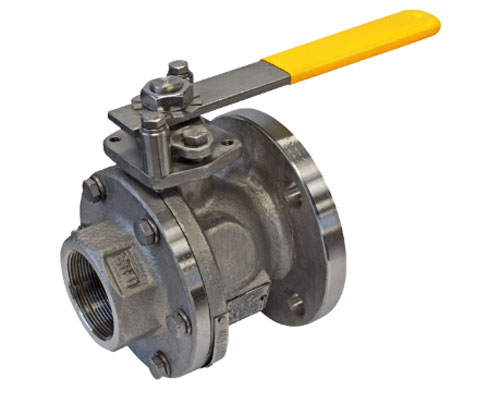
Loose Flange (Lap Joint)
A loose flange, often called a Lap Joint flange, consists of two parts: a stub end that is welded to the pipe and a backing flange that slides freely over the pipe behind the stub end. The backing flange is what gets bolted, but it doesn't touch the fluid; only the stub end does. This is a brilliant solution for expensive piping systems. For example, if you have a stainless steel pipe, you can use a stainless stub end but a cheaper carbon steel backing flange, saving significant costs. It also makes bolt alignment incredibly easy because the flange ring can rotate freely before tightening.
|
Type |
Best For |
Pros |
Cons |
|
Welded |
High Pressure/Temp |
Strongest connection, leak-proof |
Requires skilled welding, expensive |
|
Threaded |
Explosive Areas |
No welding needed, safe install |
Can loosen with vibration/heat |
|
Loose |
Expensive Materials |
Cost-saving, easy alignment |
Low pressure only, two parts needed |
Flange Sealing Surface Types
The "face" of the flange is where the gasket sits. The shape of this face determines how well the seal holds.
Plane (FF)
The Flat Face (FF) flange has a gasket surface that is in the same plane as the bolting circle face. You will almost exclusively use these when connecting to cast iron equipment or bronze valves. The reason is structural: if you tried to bolt a raised face flange to a flat cast iron flange, the bending moment caused by tightening the bolts could crack the brittle cast iron. FF flanges use full-face gaskets that cover the entire surface area, spreading the load evenly. They are typically found in low-pressure applications like water treatment or general plumbing where the stress on the flange is minimal.
Protruding Surface (RF)
The Raised Face (RF) is the most common type you will see in industrial plants. As the name suggests, the gasket surface is raised slightly above the bolting circle face. This design concentrates more pressure on a smaller gasket area, thereby increasing the pressure containment capability of the joint. It allows you to use a wide variety of gasket types, from simple flat rings to spiral wound gaskets. The RF design is the industry standard for oil, gas, and chemical processes up to roughly the Class 600 pressure rating. It provides a reliable seal that is relatively easy to install and replace.
Concave and Convex Surface (MFM)
Male and Female (MFM) flanges must be used in matched pairs. One flange has a raised area (Male) and the other has a matching depression (Female). The gasket is placed in the female depression. This design offers better gasket containment than the Raised Face type because the gasket is trapped and cannot be "blown out" by high internal pressure. It also ensures better alignment during assembly. However, availability can be a headache; if you need to replace a valve, you must ensure the new one has the exact matching face type, which makes off-the-shelf replacements more difficult to source.
Tenon Groove Surface (TG)
Similar to MFM, the Tongue and Groove (TG) face uses a raised ring (Tongue) on one flange and a matching groove on the other. This is the ultimate design for airtight sealing. The gasket is completely encapsulated in the groove, protecting it from the corrosive effects of the fluid and preventing it from expanding outward or damping. This type is critical for toxic, flammable, or explosive media where even a microscopic leak is unacceptable. The downside is that the tongue is easily damaged during transport or disassembly, so you must handle these with extreme care.
Flange Pressure Classes
Understanding pressure ratings is vital for safety; using a flange rated too low can lead to catastrophic bursts.
Different Pressure Grade Classifications
There are two main standards you will encounter: the European "PN" (Pressure Nominal) and the American "Class" (often referred to as lb or #).
-
PN Series: Common in DIN/ISO standards (e.g., PN10, PN16, PN40). The number roughly corresponds to the max pressure in bars at room temperature.
-
Class Series: Common in ASME/ANSI standards (e.g., Class 150, 300, 600, 900, 1500, 2500).
It is important to know that these are not directly interchangeable without adapters. A PN16 flange will not bolt up to a Class 150 flange because the bolt hole patterns and dimensions are different.
The Relationship Between Pressure Levels and Usage Scenarios
The "rating" is not a static number; it changes with temperature. This is a concept you must grasp: a Class 150 flange might withstand 290 psi at ambient temperature, but that capacity drops significantly as the temperature rises.
-
Low Pressure (PN10 / Class 150): Used for general water lines, compressed air, and low-risk fluids.
-
Medium Pressure (PN40 / Class 300-600): Standard for steam lines, oil transport, and process chemicals.
-
High Pressure (Class 900+): Reserved for hydraulic systems, high-pressure steam injection, and power plant applications.
Always check the pressure-temperature rating charts for the specific material you are using before installation.
Application of Flange Connections
Industrial Piping System
In general manufacturing and heavy industry, flange connections are the backbone of the infrastructure. Whether it is a car factory, a paper mill, or a steel plant, flanges serve as the connection points for steam heat, cooling water, and compressed air. They are specifically chosen here for their ability to handle vibration. Pipes in factories often shake due to machinery; threaded connections might unscrew, but a properly torqued flange connection with lock washers or tensioning will stay tight, ensuring 24/7 operational continuity.
The Petrochemical Industry
This is perhaps the most demanding sector for flanges. Here, the connections must handle aggressive acids, volatile hydrocarbons, and extreme thermal cycling. You will often see high-performance alloy flanges with Ring Joint (RTJ) faces in these settings. The priority here is leak prevention and fire safety. If a fire occurs, the flange integrity must be maintained to prevent feeding the flames. Petrochemical plants rely heavily on standardizing flange types to make maintenance turnarounds (shutdowns) faster and more efficient.
Building Water Supply and Drainage System
In commercial skyscrapers and large residential complexes, flanges are used for the main water arteries. While small pipes inside a wall might be soldered or glued, the large 6-inch or 12-inch risers in the basement are almost always flanged. This allows facility managers to replace large butterfly valves or pressure-reducing valves without cutting the pipe. In drainage, flanges are used to connect large pumps in the sewage lift stations, allowing for quick removal of a pump if it gets clogged by debris.
Application Examples in Other Fields
Beyond the factory floor, you will find flanges in the maritime industry (shipbuilding), where salt water resistance is key. They are used in food and beverage production, although these are often specialized "sanitary flanges" (like Tri-Clamp) that are easy to sterilize. You even see them in the aerospace industry for fuel lines, where weight and reliability are balanced. Essentially, anywhere a liquid or gas needs to move through a large tube that might need to be opened later, a flange is involved.
How to Choose the Appropriate Type of Flange Connection
Selecting the right flange is not just about size; it is a balance of safety, longevity, and budget.
Consider the Characteristics of the Medium
First, look at what is flowing through the pipe. Is it corrosive? If so, you might need a stainless steel flange or a lined flange. Is it toxic? If yes, you should avoid simple Flat Face flanges and opt for Tongue and Groove or Ring Joint facings to ensure a tighter seal. If the medium is a thin gas (like hydrogen), it leaks much easier than water, requiring a higher grade of surface finish on the flange face to bite into the gasket effectively.
In Combination with Installation and Maintenance Requirements
Ask yourself: How often will this joint be taken apart? If the answer is "every week for cleaning," a Loose (Lap Joint) flange is excellent because you can rotate it for easy bolt alignment, saving time. If the answer is "never," a Weld Neck flange is better because it is more permanent and robust. Also, consider the installation environment. If you are retrofitting a system in a tight corner where you cannot swing a welding torch, a Threaded or Slip-On flange might be your only practical option.
Balance Cost and Performance
Finally, you must weigh the budget. A high-pressure, Tongue and Groove, stainless steel Weld Neck flange offers the best performance, but it is overkill for a simple garden irrigation system. Conversely, using a cheap cast iron threaded flange on a high-pressure steam line is a recipe for disaster. You need to find the "sweet spot"—the most economical flange that meets all the safety and pressure coefficients of your system. Don't pay for performance you don't need, but never compromise on the safety margin.
Summary
Correct flange selection ensures safety and efficiency. Choose wisely to protect your infrastructure and minimize future maintenance costs.
FAQ
1. Can I reuse a flange gasket after disassembling the joint?
No, you should never reuse a gasket. Once compressed, a gasket loses its elasticity and ability to seal. Reusing it significantly increases the risk of leaks. Always install a fresh gasket every time you open a flange connection.
2. What is the difference between a Slip-On and a Weld Neck flange?
A Weld Neck flange is butt-welded to the pipe end and has a tapered hub for strength, making it ideal for high pressure. A Slip-On flange slides over the pipe and is welded on the surface. Slip-ons are cheaper and easier to install but weaker under fatigue.
3. How do I know which bolt tightening sequence to use?
You should always use a "star" or "crisscross" pattern. Never tighten bolts in a circle one by one. The star pattern ensures the flange face compresses the gasket evenly. Uneven tightening can crush the gasket on one side and leave a gap on the other.
4. Why are there different surface finishes on flange faces?
The roughness of the face helps "bite" into the gasket. A serrated finish (rough) is used for soft gaskets like rubber so they don't slide out. A smooth finish is required for metallic or spiral wound gaskets to create a tight seal without damaging the metal.
5. How can I ensure I am buying high-quality flanges?
Quality assurance is critical. Always look for material certification and standard stamps (like ASTM or ASME) on the flange body. At Hearken, we specialize in providing certified, high-performance flange solutions. For specific inquiries or a quote, drop us a line at info@hearkenflow.com.