 English
 Español
 Português
 Pусский
What Are the Two Primary Types of Pneumatic Actuators?
Manual production lines lead to fatigue and costly human errors. Inefficient motion control hurts your bottom line. Pneumatic actuators provide the fast, reliable, automated solutions you need to scale efficiency.
The two main types of pneumatic actuators are linear actuators (cylinders) and rotary actuators. Linear models create straight-line motion for pushing or lifting, while rotary models produce twisting force or torque. These are further categorized by operation as single-acting (using a spring return) or double-acting (using air pressure for both directions of motion).
Keep reading to understand the technical details that will help you select the best hardware for your next project.
Classification by Motion: Linear vs. Rotary
When you are browsing for components, the first thing you’ll notice is how the device moves. This is the most common way to distinguish between products in the pneumatic industry.
Linear Actuators
Linear actuators, often called air cylinders, are the workhorses of factory automation. These devices use compressed air to move a piston in a straight line, making them perfect for "push and pull" tasks. Because they are simple and durable, you can rely on them for millions of cycles with very little maintenance.
You will find these in several distinct styles:
-
Tie-rod cylinders are built for heavy-duty industrial applications.
-
Round-body cylinders are the go-to for standard, everyday automation.
-
Compact cylinders are your best friend when you have limited mounting space.
Commonly, you’ll see linear models used for pressing parts together, lifting heavy boxes, or sorting items on high-speed conveyor belts. They provide the raw force needed to keep a production line moving without a hitch.
Rotary Actuators
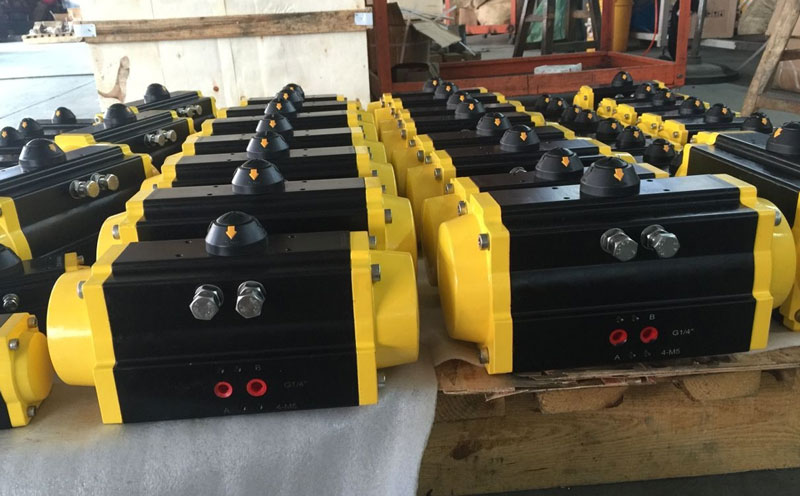
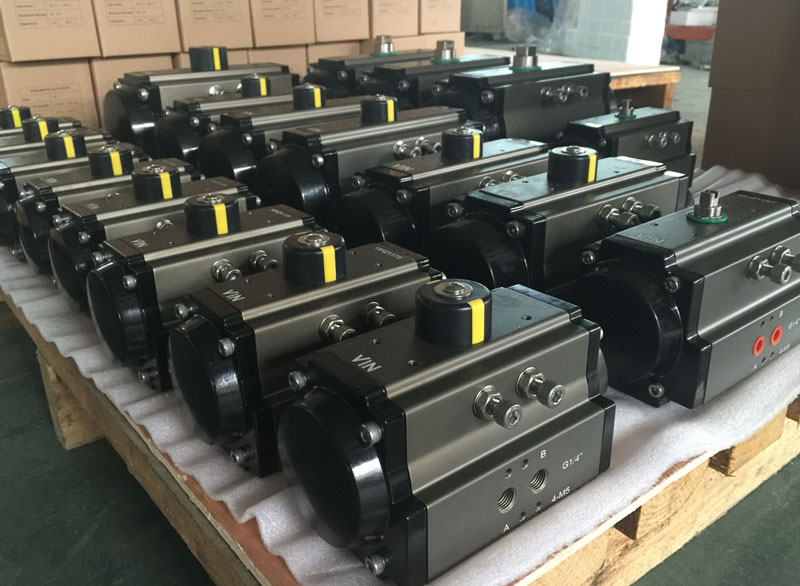
If your task requires a twisting or turning motion instead of a straight push, you need a rotary actuator. Instead of a rod extending, these devices turn air pressure into torque. This makes them essential for rotating parts or flipping components during assembly.
Two common designs dominate the market:
-
Rack and Pinion: These are great for high-torque tasks where you need very precise rotation.
-
Vane Actuators: These are much more compact and ideal for simple 90-degree or 180-degree turns.
You will frequently find rotary types used in robotic arm joints or to automate the opening and closing of large industrial valves. By knowing whether your load needs to move in a line or an arc, you can quickly narrow down your product search.
Classification by Operation: Single-Acting vs. Double-Acting
Beyond the direction of movement, you need to understand the "Air Port" configurations. This determines how your actuator uses compressed air to function.
Single-Acting Actuators
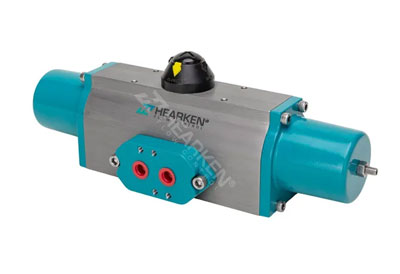
A single-acting actuator features just one air port. You apply compressed air to move the piston in one direction (usually extending it), and a built-in mechanical spring handles the return stroke once the air is vented.
This design is a smart way for you to save on air consumption costs because you only use "power" for half the cycle. Many engineers prefer these for simple clamping or as emergency shut-off valves. A huge benefit is safety; if your facility loses air pressure, the spring automatically returns the actuator to a "safe" home position, preventing machine damage.
 |
 |
| Single-Acting Actuator | Double-Acting Actuator |
Double-Acting Actuators
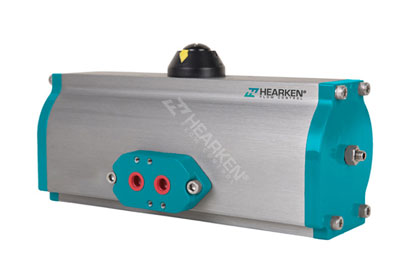
Double-acting cylinders are the more versatile sibling and the most common configuration in modern factories. These have two ports, using compressed air to power both the extension and the retraction.
Because you aren't fighting against an internal spring, you get a much more consistent force and speed in both directions. This versatility makes them the industry standard for high-speed industrial robotics. Whether you are building a complex assembly line or a long-stroke lifting system, double-acting models offer the full control you need to pull just as hard as you push. While they require slightly more air and more complex valves, their reliability and power are unmatched in heavy-duty environments.
Key Performance Differences & Selection
Choosing between these pneumatic types depends on what kind of work you need to perform. You have to match the physical tool to your specific environment and load requirements.
Comparison Overview
|
Feature |
Linear Actuator |
Rotary Actuator |
|
Output Type |
Linear Force (N / lbs) |
Torque (Nm / in-lbs) |
|
Primary Movement |
Straight Line |
Degrees of Rotation |
|
Main Shape |
Long, Cylindrical |
Blocky or Disc-shaped |
|
Common Application |
Pushing, Lifting |
Turning, Valve Control |
How to Choose the Right One
To pick the right tool, you first need to identify the task. Does the load move from Point A to Point B, or does it need to flip? If it’s a simple push, go linear. Next, evaluate your space constraints. Measure the available footprint in your machine. Sometimes a standard cylinder is too long, and you might need a compact or "rodless" version to fit.
Finally, think about your operating frequency. If your machine cycles dozens of times per minute, a double-acting cylinder is usually the better investment because it resets faster and offers better durability. Also, consider the environment—if you are working in a washdown area, you’ll likely need stainless steel. Taking these few extra minutes to plan your selection ensures that your pneumatic system runs smoothly for years.
Mastering these basic types helps you build faster, more reliable automated systems with the perfect pneumatic components for your needs. Contact Hearken today for expert guidance and high-quality actuators.
FAQ
Q1: Which type of pneumatic actuator is the most common?
Linear actuators are the most widely used because most industrial tasks involve moving objects in straight lines along assembly or packaging lines.
Q2: Can I use a single-acting cylinder for long-distance movements?
Usually no. Because they rely on a spring to return, they are typically limited to shorter stroke lengths; a very long spring would be too bulky and lose effectiveness.
Q3: What is the main benefit of a double-acting cylinder?
The biggest advantage is total control. You get equal force and speed for both the "push" and the "pull," which is essential for precision work in robotics.
Q4: Do rotary actuators require a lot of maintenance?
Not if you use clean, dry air. Like linear cylinders, they are very durable, but you should always use a filter-regulator to prevent dust from damaging the internal gears.
Q5: How do I know what size (bore) I should buy for my actuator?
You should calculate the force required for your load and then add a 25% safety margin. This ensures your actuator won't stall if there is a slight drop in air pressure.